Reclaimed Ulin Ironwood From Indonesia

Kaltimber specializes in 100% reclaimed Ulin ironwood from Indonesia, also known as Kayu Ulin, Borneo ironwood and Kalimantan ironwood. Our reclaimed Ulin is recovered from verified existing Indonesian structures, individually inspected, and manufactured in Bali into long-lasting decking, flooring and selected architectural hardwood products.
Ulin is one of Indonesia’s most durable tropical hardwoods, valued for its high density, natural resistance to termites and decay, and strong performance in demanding tropical conditions. These qualities explain its long history of use in bridges, houses, jetties, outdoor structures, flooring and other applications exposed to humidity and weather.
At Kaltimber, we focus on reclaimed Ulin rather than newly harvested Ulin. Reclaiming this exceptional ironwood gives existing material a second life while helping reduce demand for newly harvested tropical hardwood.
For product-specific information, visit our Decking and Flooring pages. For full technical details, including density, durability, mechanical properties, sourcing, SVLK, conservation and common applications, continue reading the complete Ulin guide below.

Picture by Kaltimber taken in East Kalimantan while surveying on the Sungai Mahakam
Reclaimed Ulin Ironwood From Indonesia
Reclaimed Ulin is a dense tropical hardwood recovered from existing Indonesian structures and processed for reuse. Also known as Kayu Ulin, Borneo ironwood, Kalimantan ironwood and Belian, Ulin is valued for its exceptional natural durability, high density and resistance to termites, decay and demanding tropical conditions.
Kaltimber specializes in reclaimed Ulin decking and flooring manufactured in Bali for residential, hospitality and architectural projects in Indonesia and internationally. Our reclaimed timber is recovered from existing Indonesian structures, individually inspected and processed through a traceable production system. Kaltimber operates under Indonesia’s SVLK timber legality system, supporting documented sourcing and responsible timber processing.
From private homes and villas to resorts, hotels, architects, contractors and international buyers, Kaltimber supplies reclaimed Ulin with a focus on legality, durability, material quality and responsible reuse.
Why Reclaimed Ulin Is Unique
Reclaimed Ulin combines the natural properties of one of Southeast Asia’s most durable hardwoods with the character of timber that has already served for years in previous structures. Rather than producing a perfectly uniform material, reclaimed Ulin often preserves variations in grain, tone, texture, weathering and traces of its previous use. These differences are part of the material’s architectural character.
For Kaltimber, reclaimed Ulin is not simply old timber. It is timber that has been recovered, assessed, selected, remilled and prepared for a new use. Suitable material can be transformed into precise contemporary decking and flooring while retaining the individuality that distinguishes reclaimed timber from newly manufactured uniform products.
Traceability & Responsible Sourcing
Kaltimber operates under Indonesia’s SVLK system and processes reclaimed Ulin through a documented production workflow. Each board is inspected before processing so that its dimensions, condition and suitability can be assessed before it becomes decking, flooring or another architectural component.
Reclaimed sourcing also allows valuable existing hardwood to remain in productive use instead of being discarded after the demolition or dismantling of an older structure. Reclaimed timber should not simply be assumed to be responsibly sourced because it is old; professional sourcing, documentation, processing and traceability remain important.
Common Applications
Reclaimed Ulin is particularly suitable for decking, flooring, pool decks, terraces, villas, residences, resorts, hospitality projects and selected architectural applications. Its combination of density, natural durability and reclaimed character makes it especially relevant in projects where material performance, longevity and appearance are all important.
Kaltimber’s primary focus is reclaimed Ulin decking and flooring, while selected recovered timber can also be considered for other architectural applications when dimensions, condition and available stock are suitable.
Ulin Ironwood: The Complete Guide
What Is Ulin Wood?
Ulin is the trade and local name most commonly associated with the species Eusideroxylon zwageri, a tropical hardwood tree belonging to the Lauraceae family. The species is commonly known internationally as Borneo ironwood, while regional names include Ulin, Kayu Ulin, Belian, Bulian and Kayu Besi.
Because the word “ironwood” can refer to several unrelated dense hardwood species around the world, the scientific name Eusideroxylon zwageri is the clearest way to identify true Ulin precisely.
Kew Science records the native range of Eusideroxylon zwageri as Borneo and Sumatra within the wet tropical biome. Its strong association with Borneo explains the widespread use of names such as Borneo ironwood and Kayu Ulin Kalimantan.
Is Ulin the Same as Borneo Ironwood?
Yes. Borneo ironwood is one of the most widely used English names for Eusideroxylon zwageri. In Indonesia, Kayu Ulin is widely understood, while Belian is especially common in parts of Borneo.
For search, specification and commercial purposes, the expressions Ulin wood, Kayu Ulin, Ulin ironwood, Borneo ironwood, Kalimantan ironwood and Belian can therefore refer to the same species. The terminology varies by language and region, but the botanical identity remains Eusideroxylon zwageri.
Botanical Characteristics of the Ulin Tree
Ulin is an evergreen tropical tree capable of reaching substantial dimensions. Technical references describe mature specimens reaching approximately 40 metres in height, with long straight boles and large trunk diameters in mature forest conditions. The base can develop small rounded buttresses.
The species belongs to the Lauraceae family, the same botanical family that includes plants such as cinnamon, bay and avocado. Ulin is adapted to humid tropical forest environments and has long formed part of the ecological, material and cultural landscape of Borneo.
Where Does Ulin Grow?
The native distribution of Eusideroxylon zwageri is primarily Borneo and Sumatra. The species is associated mainly with humid lowland tropical forest environments and is particularly strongly associated with Kalimantan and other parts of Borneo.
This geographical origin explains why searches and trade terminology frequently use expressions such as Kayu Ulin Kalimantan, Borneo ironwood and Kalimantan ironwood.
Is Ulin a Slow-Growing Tree?
Yes. Ulin is widely recognised as a slow-growing tropical tree, and natural regeneration can be difficult in disturbed forest environments. Its slow growth and pressure on natural populations make responsible resource management particularly important.
For Kaltimber, this strengthens the rationale for working primarily with reclaimed Ulin. Reusing timber that has already been harvested and incorporated into previous structures extends the productive life of an existing natural resource instead of treating highly durable old timber as waste.
Ulin Wood Properties
Density
Ulin is an exceptionally dense hardwood. Technical data published by the International Tropical Timber Organization reports a basic density of approximately 0.88 g/cm³ and an air-dry density of approximately 1.02 g/cm³ at 12% moisture content.
This high density is one of the reasons behind Ulin’s reputation as an “ironwood.” It contributes to high wear resistance, substantial weight, resistance to physical impact and a solid feel when used as decking or flooring.
Density also affects manufacturing and installation. Ulin should not be machined, drilled or fastened in the same way as a lightweight softwood. Suitable machinery, tools, cutters and installation techniques are important when working with the species.
Natural Durability
Natural durability is one of Ulin’s defining characteristics. ITTO gives Ulin a Natural Durability Index of 1, representing the highest durability category in that particular classification system, and describes the heartwood as very durable.
This exceptional natural durability helps explain Ulin’s historical use in demanding exterior, structural and tropical applications. It is also one of the reasons reclaimed Ulin recovered from older structures can still contain timber suitable for further architectural use after careful inspection and remilling.
Natural durability should not, however, be confused with indestructibility. Even a highly durable hardwood performs best when drainage, ventilation, joist spacing, fastening systems, substrate preparation and other construction details are correctly designed.
Termite Resistance
Ulin possesses strong natural resistance to termites. This is particularly relevant in tropical regions, where termite exposure can be an important factor when selecting timber for flooring, decking and structural applications.
For projects in Bali and elsewhere in Indonesia, termite resistance is therefore not simply a marketing description. It is one of the established technical characteristics that have contributed to the long-standing use of Ulin in tropical construction.
Resistance to Decay and Wood-Destroying Organisms
Ulin heartwood is highly resistant to biological deterioration. Technical references describe strong resistance to wood-rotting fungi, termites and several other wood-destroying organisms.
These characteristics help explain why Ulin was historically selected for bridges, posts, exterior structures and other demanding applications. They also explain why suitable reclaimed Ulin can remain structurally useful after many years in service.
Marine Borer Resistance
Ulin has historically been used in marine and port environments because of its natural resistance to biological attack, including marine borers. Technical references record historical applications in shipbuilding, port structures and other wet environments.
This does not mean that every Ulin product should automatically be specified for every marine application. Exposure, engineering requirements, fasteners and structural design still need to be professionally evaluated. The historical record does, however, demonstrate the unusually high natural durability of Ulin heartwood.
Colour, Grain and Appearance
What Colour Is Ulin Wood?
Ulin changes considerably in appearance depending on age, processing and exposure. Fresh or newly machined heartwood can show yellow-brown, reddish-brown, olive-brown and related tones, while exposure can cause the timber to become significantly darker.
Reclaimed Ulin can therefore display substantial colour variation. A weathered exterior surface recovered from an old structure may look completely different from the freshly machined interior of the same piece of timber.
This contrast is one of the distinctive visual characteristics of reclaimed Ulin and can create considerable variation even within material produced from the same recovered source.
Grain and Texture
Ulin generally has a straight grain, although interlocked grain can occasionally occur. Its texture is generally described as fine to medium.
Different manufacturing and finishing methods reveal the grain and reclaimed character in different ways. A smooth sanded surface produces a cleaner and more refined architectural appearance, while wire-brushing and rustic finishing can expose more texture, age and visual variation.
For flooring, Kaltimber also produces an Exotic Finish in which smooth and rustic areas are deliberately combined on each individual board.
Why Does Reclaimed Ulin Look Different From New Timber?
Reclaimed wood has already lived a previous life. Exposure, previous machining, weathering, fastening marks, colour changes and years of use can all contribute to visual variation.
When Kaltimber remills reclaimed Ulin, the objective is to prepare the timber for precise modern use while retaining the natural individuality that distinguishes reclaimed material from newly manufactured uniform products.
Two boards can therefore share the same species, dimensions and finish while displaying subtle differences in grain, tone and character. For many architects, designers and homeowners, this individuality is one of the reasons for selecting reclaimed timber.
Technical Performance of Ulin
Physical and Mechanical Properties
For architects, designers and technical buyers, Ulin’s reputation is supported by measurable physical and mechanical properties rather than appearance alone.
| Property | Approximate Reported Value |
|---|---|
| Basic density | 0.88 g/cm³ |
| Air-dry density at 12% MC | 1.02 g/cm³ |
| Tangential shrinkage | 7.7% |
| Radial shrinkage | 4.3% |
| Tangential / radial ratio | 1.8 |
| Bending strength at 12% MC | ≈ 162 MPa |
| Modulus of elasticity at 12% MC | ≈ 18.2 GPa |
| Compression parallel to grain | ≈ 80 MPa |
| Radial shear strength | ≈ 12.7 MPa |
| Lateral Janka hardness | ≈ 12.5 kN |
| Natural durability index | Class 1 |
These figures help explain why Ulin has historically been selected for high-wear and demanding applications. They should nevertheless be understood as representative species data rather than a structural certification for every individual reclaimed board.
Reclaimed timber has its own history, which is why recovered material must still be inspected and selected according to its intended use.
Dimensional Movement and Drying
Like all natural timber, Ulin responds to changes in moisture content. Technical references report total tangential shrinkage around 7.7% and radial shrinkage around 4.3%.
Ulin is reported to season relatively well for such a dense hardwood, but this does not eliminate the need for correct moisture management, installation detailing and project-specific assessment.
For flooring and decking, board dimensions, substrate conditions, ventilation, drainage, acclimatisation where appropriate, fastening systems and installation methods all influence long-term performance.
Machining Ulin
Ulin’s density is an advantage in service but creates additional demands during manufacturing. Its hardness can dull cutting tools more quickly than softer timbers, and appropriate machinery and cutters are important when processing the material.
Pre-drilling is generally recommended when fastening dense Ulin, and professional machining is particularly important when producing accurate profiles for decking and flooring.
Turning an old structural timber into a finished architectural product involves considerably more than simply cutting an old beam into boards. Material selection, inspection, metal detection where appropriate, milling, profiling, sanding and quality control all form part of the production process.
Historical Uses of Ulin Wood
The physical and biological properties of Ulin explain its long history in Southeast Asian construction. Traditional and historical applications include bridges, structural posts, heavy housing construction, flooring, shipbuilding, port structures, exterior construction and timber roof shingles.
Ulin shingles are commonly known as sirap in Indonesia. The species has also been used in engineering environments where builders needed timber capable of tolerating humidity, insects and prolonged outdoor exposure.
This history is particularly relevant to reclaimed Ulin. Many of the structures that later become sources of recoverable timber were originally constructed using Ulin precisely because the builders expected the material to perform for a very long time.
Why Reclaim Ulin?
Reclaimed Ulin vs Newly Harvested Ulin
The distinction between reclaimed Ulin and new Ulin is fundamental. Newly harvested Ulin comes from a recently felled tree, while reclaimed Ulin comes from timber that has already been incorporated into an existing structure or previous use and is subsequently recovered for reuse.
Kaltimber’s core Ulin business follows the second model. We recover suitable material from existing Indonesian structures, inspect it and give it a new architectural life.
Reclaimed does not mean that every old piece of timber is automatically usable. Recovered boards and beams must still be assessed, selected and processed. Material that remains suitable can then be remilled rather than discarded.
Is Reclaimed Ulin the Same as Recycled Ulin?
In everyday search language, the expressions reclaimed Ulin and recycled Ulin are often used interchangeably. Kaltimber primarily uses the term reclaimed Ulin because it more accurately describes solid timber recovered from previous structures and reused in a new application.
The expressions recycled Ulin and recycled ironwood remain useful and widely understood, particularly in online searches. Technically, however, the timber is generally not broken down and remanufactured in the same way that paper, plastic or composite materials are recycled. The solid hardwood itself is recovered, remilled and reused.
Ulin and Conservation
Why Responsible Ulin Sourcing Matters
Ulin’s exceptional performance has also contributed to pressure on the species. Natural populations have been affected by logging, habitat disturbance and slow regeneration, and conservation research has raised concerns about the long-term regeneration of Borneo ironwood in disturbed forests.
This makes sourcing particularly important. Kaltimber’s focus on reclaimed Ulin is based on a straightforward principle: when suitable Ulin already exists in dismantled structures, there is value in preserving and reusing that material rather than treating it as waste.
Kaltimber also supports Ulin replanting initiatives through trusted partners in Indonesia, contributing to the planting of more than 1,000 Ulin trees annually.
Ulin Replanting and Mother Tree Awareness
Protecting mature Ulin trees matters because mother trees are the source of seeds for future regeneration. Ulin grows slowly, and natural regeneration can be limited by seed survival, growing conditions, disturbance and competition from surrounding vegetation.
Kaltimber’s approach combines reclaimed timber use with environmental initiatives connected to Ulin replanting and native species restoration. By using reclaimed Ulin instead of newly harvested ironwood, while also supporting replanting and awareness around mother trees, Kaltimber helps promote a more responsible future for one of Indonesia’s most important tropical hardwoods.
Is Ulin CITES Listed?
Current technical references list Ulin as unrestricted under CITES. This should not be confused with timber legality, national forestry regulation or export documentation.
CITES status is only one element of international timber regulation. The legal sourcing, processing and movement of timber remain subject to Indonesian regulations and, for export projects, the requirements applicable to the destination market and product concerned.
SVLK and Traceability
SVLK is Indonesia’s timber legality and sustainability verification system. It provides a regulated framework for demonstrating that timber and timber products processed and traded through Indonesia comply with applicable legal requirements.
Kaltimber operates under SVLK and integrates traceability into its reclaimed timber processing. This is especially important because reclaimed timber should not automatically be assumed to be legal simply because the material is old.
For professional buyers, architects, contractors and export customers, documentation and traceability provide an additional layer of confidence alongside the physical quality of the timber itself.
Reclaimed Ulin Decking
Ulin’s natural durability, high density and resistance to termites make it particularly relevant for exterior decking in tropical environments. Kaltimber manufactures reclaimed Ulin decking in Bali for applications including pool decks, terraces, villas, resorts, hotels, walkways and other outdoor architectural spaces.
Board widths, lengths, profiles and finishes can be selected according to project requirements. Kaltimber has no minimum order quantity for reclaimed Ulin decking, allowing the same specialist material to be supplied for a small residential terrace, private villa, hospitality project or significantly larger development.
Correct installation remains important. Board spacing, ventilation, drainage, supporting structures, fastening methods and exposure conditions all influence the long-term performance of exterior timber.
Explore Reclaimed Ulin Decking
Reclaimed Ulin Flooring
Ulin also has a long history as a flooring timber, and its density, hardness and natural durability make it suitable for high-quality solid hardwood flooring.
Kaltimber manufactures reclaimed Ulin flooring in Bali for villas, residences, hotels, resorts and architectural interiors. Available finishes include Smooth, Rustic and Exotic Finish, while dimensions and profiles can be selected according to project requirements and available reclaimed stock.
Processing strongly influences the final appearance. Smooth Ulin flooring can feel refined and contemporary, while rustic finishing preserves more visible texture and reclaimed character. Exotic Finish combines smooth and rustic areas on each individual board to create a distinctive contrast within the same flooring surface.
Kaltimber has no minimum order quantity for reclaimed Ulin flooring and can work with both small interior projects and larger hospitality or architectural requirements.
Explore Reclaimed Ulin Flooring
Ulin in Wet and Outdoor Environments
Is Ulin Suitable Around Swimming Pools?
Yes. Ulin’s natural durability makes it particularly well suited to poolside decking when the system is correctly designed and installed.
Pool environments are demanding because timber is repeatedly exposed to rain, splashing, humidity, strong sunlight and changing moisture conditions. Material selection therefore matters, but drainage, ventilation, board spacing, suitable fasteners and installation quality are equally important.
A naturally durable hardwood cannot compensate for poor construction detailing. Correct installation remains essential for long-term performance.
Is Ulin Waterproof?
“Waterproof” is not the correct technical description for any natural timber. Ulin is highly durable and has a long history of use in demanding wet environments, but it remains a natural hygroscopic material that exchanges moisture with its surroundings.
A more accurate description is that Ulin possesses very high natural durability and strong resistance to biological deterioration in demanding tropical and wet environments.
Good drainage and appropriate detailing should still be incorporated into outdoor construction.
Can Ulin Be Used Outdoors?
Yes. Outdoor construction is one of the applications for which Ulin is particularly well known.
Historical applications include bridges, posts, exterior construction, port structures and shingles. Modern reclaimed Ulin is particularly suitable for decking, terraces, pool surrounds, garden areas, walkways and other outdoor architectural spaces.
Finishing and Maintenance
Does Ulin Need Chemical Treatment?
Ulin heartwood is naturally highly durable and does not depend on conventional preservative treatment to obtain the fundamental durability for which the species is known.
Because the timber is extremely dense, preservative impregnation can also be difficult. Exterior oils and finishing products are generally used primarily to influence appearance, surface behaviour and maintenance rather than to transform an inherently non-durable species into a durable one.
The appropriate finishing system depends on the desired appearance, exposure and project requirements.
Does Ulin Need to Be Oiled?
Not necessarily. Ulin can be allowed to weather naturally, in which case sunlight and exposure gradually change the appearance of the wood.
Clients who prefer a richer or darker timber tone can periodically apply an appropriate exterior decking oil according to the manufacturer’s recommendations.
Oiling should therefore be understood mainly as part of an appearance and maintenance strategy rather than the source of Ulin’s underlying natural durability.
How Does Ulin Age?
Ulin changes naturally over time. Newly exposed or freshly machined timber can show yellow-brown, reddish-brown or olive-brown tones, while exposure to sunlight, rainfall and the surrounding environment gradually alters the colour.
Exterior surfaces may develop different appearances depending on orientation, exposure and maintenance. Reclaimed Ulin can show even greater variation because different surfaces may already have experienced years of weathering before the timber was recovered.
This natural evolution is one of the reasons reclaimed Ulin develops such a distinctive architectural character.
Ulin for Interior Applications
Can Ulin Be Used Indoors?
Yes. Ulin is not limited to exterior applications. Flooring is one of its established uses, and reclaimed Ulin can create distinctive solid hardwood floors in villas, residences, hotels, restaurants and other hospitality interiors.
For indoor projects, board dimensions, moisture conditions, substrate preparation, installation method, finishing system and desired appearance should all be considered.
Because reclaimed timber varies naturally, clients should expect character and visual variation rather than the absolute uniformity of a synthetic flooring product.
Working With Ulin
Is Ulin Difficult to Machine?
Compared with softer timbers, Ulin requires appropriate machinery and experience because of its density and hardness. Cutting tools must be suitable for dense tropical hardwood, and pre-drilling is generally recommended for fastening.
For professional manufacturers, these characteristics are manageable. They do, however, reinforce why reclaimed Ulin needs to be properly processed rather than treated like ordinary lightweight timber.
At Kaltimber, recovered material is inspected and machined according to the product being produced, whether decking, flooring or another architectural component.
Is Every Piece of Reclaimed Ulin the Same?
No. Variation is inherent to reclaimed timber.
Boards may differ in grain, colour, previous exposure, original dimensions, weathering and surface character. Kaltimber therefore assesses recovered timber before processing and selects material according to its condition and intended application.
For architectural projects, this means clients should expect the natural individuality of reclaimed wood rather than perfect visual uniformity.
Why Architects Specify Reclaimed Ulin
Architects and designers may select reclaimed Ulin for several reasons simultaneously. It offers measurable natural durability, a long technical history in tropical construction, resistance to termites and decay, distinctive reclaimed character and the opportunity to reuse an existing material rather than relying entirely on newly harvested timber.
For Kaltimber projects, the principal applications are decking and flooring. Selected recovered stock can also be considered for other architectural uses where dimensions, condition and available material are appropriate.
Reclaimed Ulin can therefore provide both technical performance and a visible material story, particularly in projects where natural materials and long-term durability are important design considerations.
What Makes Kaltimber’s Reclaimed Ulin Different?
Kaltimber has specialized in reclaimed Ulin in Bali since 2009. Our role is not simply to trade old timber. We recover, select, inspect, remill and manufacture reclaimed Ulin into finished architectural products, with decking and flooring at the core of our production.
Each reclaimed board has to pass through a process of evaluation and manufacturing before it can become part of a new project. This allows recovered structural material to be transformed into accurate contemporary products while preserving the character that makes reclaimed Ulin distinctive.
Kaltimber works with private clients, architects, designers, contractors, resorts and hospitality professionals. We can supply small residential requirements as well as significantly larger projects, and there is no minimum order quantity.
For clients in Bali, samples and available finishes can be viewed directly through Kaltimber. For projects elsewhere in Indonesia or internationally, dimensions, drawings and specifications can be reviewed before quotation.
Reclaimed Ulin in Bali
Bali’s tropical climate creates demanding conditions for timber. High humidity, heavy rainfall, termites, strong sunlight and frequent indoor-outdoor architectural design mean that both material selection and installation quality matter.
Ulin’s natural durability has made it particularly relevant for tropical construction, while reclaimed Ulin adds the architectural character and resource efficiency of reusing an existing material.
Kaltimber manufactures reclaimed Ulin decking and flooring in Bali and supplies projects throughout the island, elsewhere in Indonesia and internationally.
For detailed information in Bahasa Indonesia about Kayu Ulin Bali, Kayu Ulin bekas, Decking Ulin, Lantai Ulin, pricing, specifications and ordering:
Frequently Asked Questions About Ulin Ironwood
What is Ulin?
Ulin is a dense tropical hardwood species scientifically known as Eusideroxylon zwageri. It is native primarily to Borneo and Sumatra and is also known as Borneo ironwood, Kayu Ulin, Kalimantan ironwood and Belian.
What is Ulin in English?
Ulin is commonly translated as Borneo ironwood or ironwood in English. Its scientific name is Eusideroxylon zwageri. Depending on the region, Ulin is also known as Kayu Ulin, Belian, Bulian, Kalimantan ironwood and Kayu Besi.
Is Ulin a hardwood?
Yes. Ulin is an exceptionally dense tropical hardwood belonging to the Lauraceae family.
Is Ulin naturally termite resistant?
Yes. Ulin heartwood possesses strong natural resistance to termite attack, one of the properties that has made the species particularly valuable in tropical construction.
Is Ulin resistant to decay?
Yes. Ulin is classified as a very durable timber and possesses strong natural resistance to biological deterioration, including wood-rotting fungi.
Is Ulin suitable for decking?
Yes. Ulin’s high natural durability, density and history of demanding exterior use make it particularly suitable for outdoor decking when correctly specified and installed.
Is Ulin suitable for flooring?
Yes. Flooring is one of the established uses of Ulin. Kaltimber manufactures solid reclaimed Ulin flooring for residential, hospitality and architectural interiors.
What is reclaimed Ulin?
Reclaimed Ulin is Ulin timber recovered from an existing structure or previous use and processed again for a new application rather than being sourced directly from a newly harvested tree.
Is reclaimed Ulin the same as recycled Ulin?
The expressions are often used interchangeably in everyday language and online searches. Kaltimber primarily uses “reclaimed Ulin” because the solid timber itself is recovered, remilled and reused rather than being broken down into a new manufactured material.
Where does Ulin come from?
The native range of Eusideroxylon zwageri is primarily Borneo and Sumatra, which explains its strong association with Kalimantan and the common international name Borneo ironwood.
How dense is Ulin?
Technical data reports an air-dry density of approximately 1.02 g/cm³ at 12% moisture content, making Ulin one of the denser tropical hardwoods commonly used in construction.
What durability class is Ulin?
ITTO gives Ulin a Natural Durability Index of 1, representing the highest durability category within its classification system.
Does Ulin change colour?
Yes. Freshly machined Ulin can show yellow-brown, reddish-brown and related tones and may darken considerably with exposure. Reclaimed material can show additional variation resulting from its previous use and weathering.
Does Ulin need to be oiled?
Not necessarily. Ulin can weather naturally. Exterior oil can be used where clients prefer to maintain a richer or darker timber appearance.
Is Ulin waterproof?
No natural timber should technically be described as completely waterproof. Ulin is exceptionally durable in wet and tropical conditions, but correct drainage and installation remain important.
Can Ulin be used indoors?
Yes. Reclaimed Ulin can be used for solid hardwood flooring and other selected interior architectural applications.
Does Kaltimber sell newly harvested Ulin?
Kaltimber’s core Ulin business is based on reclaimed Ulin recovered from existing Indonesian structures and processed for reuse.
Does Kaltimber have a minimum order quantity?
No. Kaltimber can supply reclaimed Ulin for small residential projects as well as larger hospitality and architectural requirements.
Can Kaltimber supply reclaimed Ulin outside Bali?
Yes. Kaltimber supplies projects elsewhere in Indonesia and internationally, subject to specifications, logistics and applicable documentation requirements.
Can I see reclaimed Ulin in Bali?
Yes. Clients can contact Kaltimber to view reclaimed Ulin decking, flooring, samples and available finishes in Bali. Architects, designers and contractors can also send drawings or specifications before visiting so that relevant options can be prepared.
Giving Ulin a New Architectural Life
Ulin is an exceptional material, but its value should not be measured only by how hard, dense or durable it is. A board of reclaimed Ulin represents a natural resource that has already served one purpose and can potentially serve another.
That principle is at the centre of Kaltimber’s approach. By recovering suitable Ulin from existing structures, inspecting it carefully and remilling it into new decking, flooring and selected architectural products, we extend the useful life of an already harvested tropical hardwood.
The result combines technical performance, material history and contemporary architectural use. Rather than attempting to erase every mark of age and previous use, reclaimed Ulin allows those characteristics to become part of a new project.
For Kaltimber, that is what reclaimed Ulin means: giving an exceptional existing material a new architectural life.
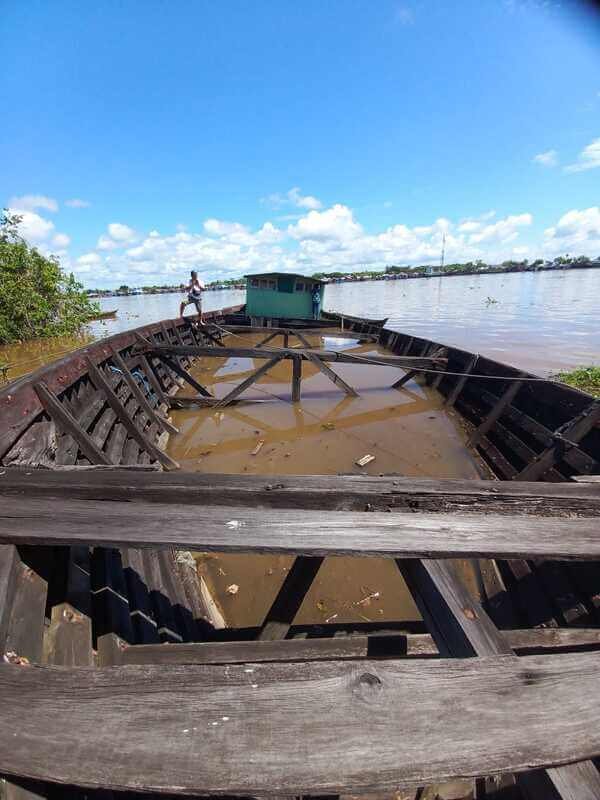
Photo by Kaltimber
Looking for reclaimed Ulin timber in Bahasa Indonesia? Visit our Indonesian guide to Kayu Ulin bekas, reclaimed ironwood sourcing, decking Ulin, lantai Ulin, specifications, SVLK and ordering in Bali or elsewhere in Indonesia.
Mencari Kayu Ulin Bekas di Bali?
Kaltimber memproduksi dan memasok 100% reclaimed Kayu Ulin / Kayu Ulin bekas untuk decking Ulin, lantai Ulin dan proyek arsitektur di Bali dan seluruh Indonesia. Pelajari pilihan produk, ukuran, finishing, sourcing, SVLK dan cara mendapatkan penawaran dalam panduan lengkap kami.