
8 Remarkable Animals Living in Kalimantan
Originally published June 6, 2022. Updated August 2026.
Kalimantan, the Indonesian part of the island of Borneo, is home to some of the most extraordinary wildlife on Earth.
Its tropical rainforests, peatlands, mangroves, rivers and coastlines provide habitats for thousands of animal species. Some, such as the proboscis monkey, are found nowhere else in the world. Others, including the Bornean orangutan and the helmeted hornbill, are now dangerously close to extinction.
Orangutans may be the most famous animals living in Kalimantan, but they represent only one part of a much larger and more complex ecosystem.
Proboscis monkeys move through riverside forests. Hornbills carry seeds across the rainforest canopy. Sun bears search inside trees for insects and honey. Asian arowana inhabit dark forest rivers, while green and hawksbill turtles connect Kalimantan’s coastal ecosystems with the wider seas of Southeast Asia.
Learning about these animals is not simply a matter of curiosity. Understanding how they live, what threatens them and why their habitats matter is one of the first steps towards protecting them.
Here are eight remarkable animals living in Kalimantan.
Bornean Orangutan
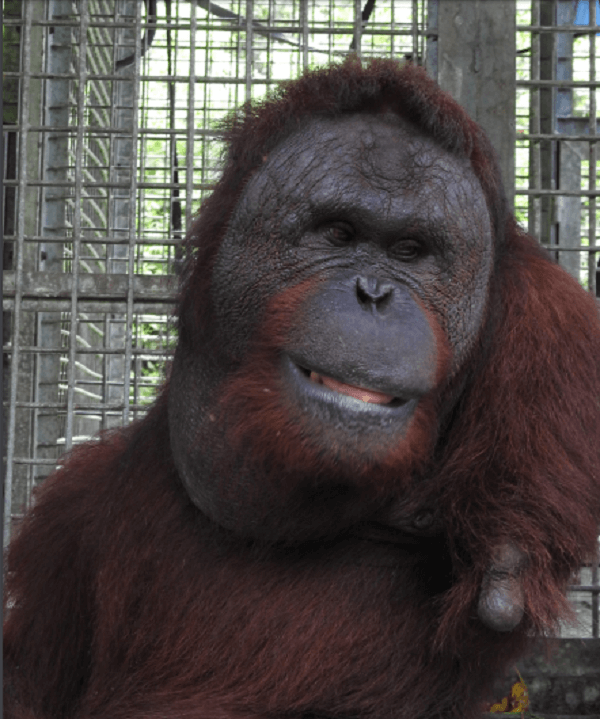
The Bornean orangutan, scientifically known as Pongo pygmaeus, is probably the most recognisable animal in Kalimantan.
The name orangutan comes from the Indonesian and Malay words orang hutan, commonly translated as “person of the forest.” It is an appropriate name for one of our closest animal relatives.
Bornean orangutans are highly intelligent great apes. They can use tools, build a new sleeping nest almost every night and learn behaviours from other members of their population.
They spend much of their lives in the forest canopy, feeding primarily on fruit. They also eat leaves, bark, insects and other available foods.
As orangutans move through the forest and consume fruit, they help spread seeds over large areas. This makes them important contributors to forest regeneration.
Unfortunately, the Bornean orangutan is classified as Critically Endangered.
Its population has declined because of habitat loss, forest fragmentation, fires, hunting and conflict with humans. When forests are cleared or divided by roads, mines and plantations, orangutans can become trapped in increasingly small areas.
Protecting orangutans therefore requires more than rescuing individual animals. It requires the protection and reconnection of large areas of natural forest where wild populations can survive and reproduce.
Proboscis monkey
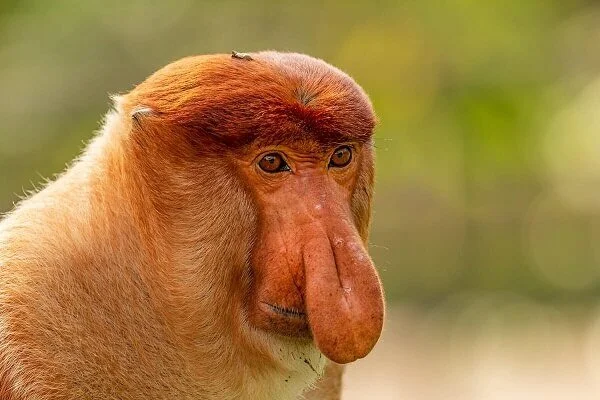
The proboscis monkey, Nasalis larvatus, is one of Borneo’s most distinctive animals.
Adult males are famous for their unusually large noses. Although their appearance often attracts attention, the species is far more interesting than its nose alone.
Proboscis monkeys are excellent swimmers. They have partly webbed feet and are regularly seen crossing rivers or moving through mangroves, wetlands and flooded forests.
They generally live close to water and feed on leaves, seeds and unripe fruit.
The proboscis monkey is endemic to Borneo. This means that it is naturally found nowhere else in the world.
It is currently classified as Endangered.
The destruction of mangroves, peatlands and riverine forests has reduced and divided much of its natural habitat. In some areas, populations are now restricted to narrow strips of vegetation along rivers.
These remaining forest corridors are essential. Without them, groups of proboscis monkeys become isolated and increasingly vulnerable.
Southern pig-tailed macaque
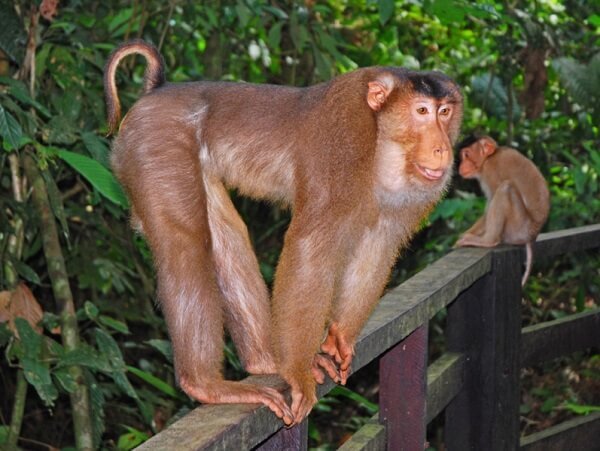
The southern pig-tailed macaque, Macaca nemestrina, takes its name from its short tail, which is often carried in a raised position and resembles the tail of a pig.
Despite sometimes being described as a very small primate, it is actually a solidly built, medium-sized macaque.
Pig-tailed macaques spend time both in trees and on the forest floor. They live in social groups and eat a varied diet that includes fruit, seeds, young leaves, insects and other forest foods.
Their ability to adapt to different environments means they are sometimes seen near roads, farms or settlements.
However, seeing macaques close to humans does not necessarily mean that their wild populations are secure.
The southern pig-tailed macaque is classified as Endangered. Its numbers have declined because of forest loss, hunting, capture and conflict with agriculture.
Animals that remain visible around human settlements can create the false impression that the species is still abundant. In reality, healthy populations living inside undisturbed forests may be declining.
Sun Bear
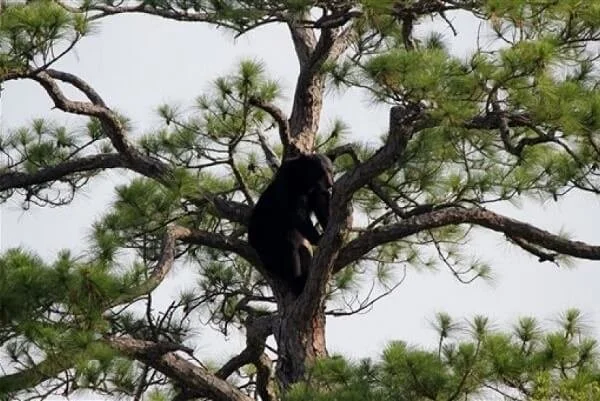
The sun bear, Helarctos malayanus, is the smallest bear species in the world.
It has short black fur, powerful claws and a pale marking on its chest. The shape of this marking is different on every animal.
Sun bears are sometimes called honey bears because of their fondness for honey. However, their diet is much more varied.
They also eat fruit, termites, beetle larvae and other insects. Their long tongues help them reach food inside tree cavities and fallen logs.
Sun bears are skilled climbers and spend a considerable amount of time searching for food in trees.
Their feeding behaviour plays an important role in the forest. By breaking apart decaying wood, opening tree cavities and spreading seeds, they help create opportunities for other animals and plants.
Sun bears are generally solitary and difficult to observe in the wild.
They are classified as Vulnerable and are threatened by forest destruction, fires, hunting and illegal wildlife trade.
Because they are rarely seen, their disappearance can occur without attracting the same public attention as the decline of orangutans.
Asian Arowana Fish
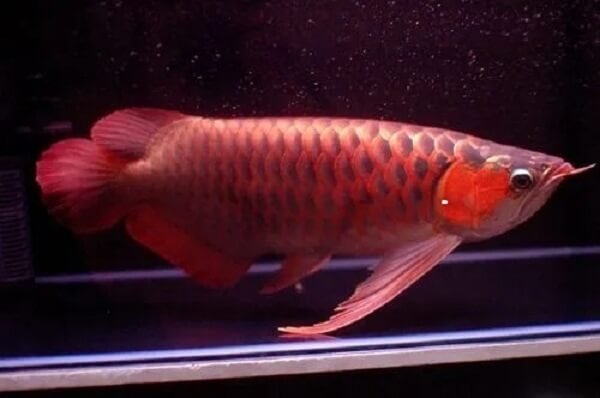
The Asian arowana, Scleropages formosus, is one of Southeast Asia’s most famous freshwater fish.
It naturally inhabits slow-moving rivers, forest wetlands and dark waters stained by leaves and other organic material.
Adult Asian arowana feed mainly on other fish and small animals. Younger fish may also eat insects and other invertebrates.
Several colour varieties, particularly red arowana, are highly valued in the international ornamental fish trade. Individual fish can be sold for extremely high prices.
This commercial value has placed considerable pressure on wild populations.
The Asian arowana is classified as Endangered and is protected under the Convention on International Trade in Endangered Species, commonly known as CITES.
International trade in wild Asian arowana is heavily restricted. Registered captive-breeding operations may trade legally produced fish under strict documentation and traceability requirements.
This distinction is important. A legally bred and properly documented fish is not the same as an animal illegally removed from a river in Kalimantan.
Protecting Asian arowana also requires protecting the rivers and forest wetlands where they live.
When surrounding forests are cleared, changes in water temperature, sediment, pollution and water chemistry can damage habitats that support highly specialised aquatic species.
Hornbill Bird
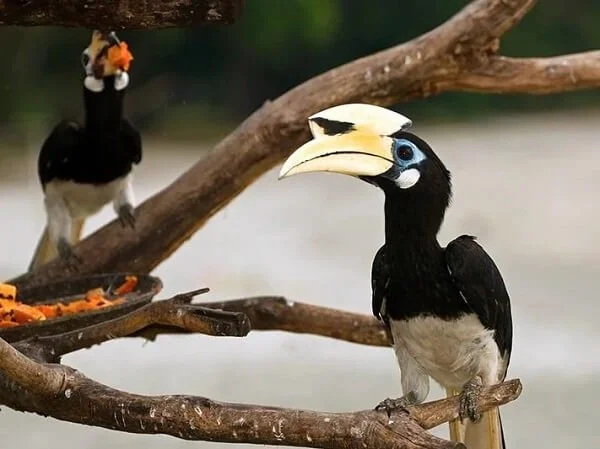
Hornbills are among the most spectacular birds living in Kalimantan.
They are known locally in many parts of Indonesia as enggang or julang. Their large bills and prominent casques make them easy to recognise.
Several hornbill species live in Borneo, including the rhinoceros hornbill and the helmeted hornbill.
These birds are important seed dispersers.
Hornbills consume forest fruits and transport the seeds over considerable distances. In doing so, they help trees regenerate across the rainforest.
This has earned them a reputation as gardeners of the forest.
Hornbills also depend on mature trees for nesting. Females usually lay their eggs inside natural tree cavities.
When old forests are cleared, suitable nesting sites disappear. A young plantation may contain many trees, but it cannot immediately replace the complex habitat provided by mature rainforest.
Different hornbill species face different levels of danger.
The rhinoceros hornbill is classified as Vulnerable, while the helmeted hornbill is classified as Critically Endangered.
The helmeted hornbill faces an additional threat because its solid casque is illegally traded as a material sometimes called hornbill ivory.
The disappearance of hornbills affects more than the birds themselves. Forests also lose some of their most effective long-distance seed dispersers.
Lesser Mouse Deer
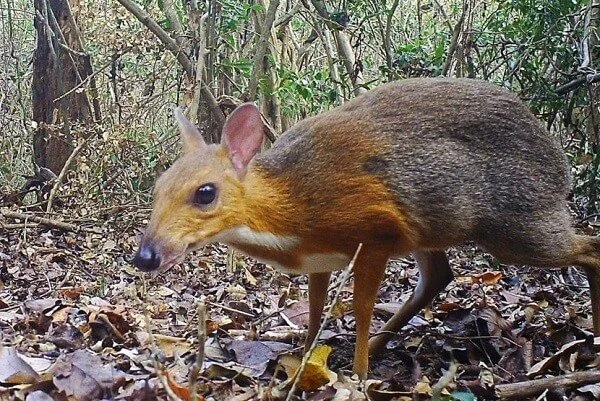
The lesser mouse-deer, Tragulus kanchil, is known in Indonesia as the kancil.
Despite its English name, it is neither a mouse nor a true deer. It belongs to an ancient family of small hoofed mammals called chevrotains.
The lesser mouse-deer has a small body, thin legs and a cautious nature. It usually remains close to dense vegetation, where it can hide from predators.
It feeds on leaves, shoots, fallen fruit and other plant material found near the forest floor.
The kancil also has an important place in Indonesian and Malay folklore.
In traditional stories, Sang Kancil is a small but clever character who defeats or escapes much stronger animals through intelligence rather than physical power.
Unlike several animals in this article, the lesser mouse-deer is currently classified globally as Least Concern.
However, this does not mean that its habitat can be ignored.
Even species that are not globally endangered can disappear from particular areas because of hunting, fires and forest clearance.
Conservation should not begin only when an animal is already close to extinction.
Green and Hawksbill turtles
Kalimantan’s wildlife does not end at the edge of the rainforest.
Its rivers, mangroves, islands, coral reefs and coastal waters connect the island with the wider marine ecosystems of Southeast Asia.
Six of the world’s seven marine turtle species have been recorded in Indonesian waters.
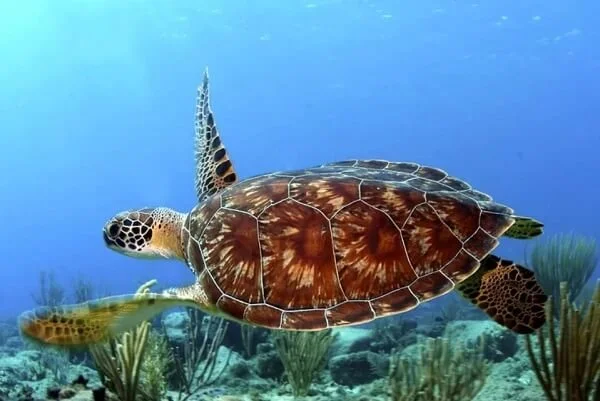
These include the green turtle, Chelonia mydas, and the hawksbill turtle, Eretmochelys imbricata.
Green turtles feed largely on seagrass and algae. Their grazing helps maintain healthy and productive seagrass ecosystems.
Hawksbill turtles are closely associated with coral reefs. Their narrow beaks allow them to reach food between rocks and corals, including marine sponges.
Both species are threatened.
Green turtles are classified as Endangered, while hawksbill turtles are classified as Critically Endangered.
They face many of the same dangers, including accidental capture in fishing equipment, coastal construction, plastic pollution, hunting and the collection of their eggs.
Hawksbill turtles have also been heavily hunted for their patterned shells, which have historically been used to produce objects sold as tortoiseshell.
Sea turtles often return to the same beaches where they were born in order to lay their eggs.
The destruction or disturbance of a single nesting beach can therefore affect generations of turtles.
Why Are So Many Animals in Kalimantan Endangered?
There is no single cause behind the decline of Kalimantan’s wildlife.
The main threats include forest conversion, unsustainable logging, mining, road construction, fires, hunting, wildlife trafficking, river pollution and the destruction of coastal habitats.
Palm oil development has been an important cause of forest conversion in some parts of Borneo, but it is not the only pressure affecting wildlife.
Different animals depend on different habitats.
Orangutans require connected forests. Proboscis monkeys depend heavily on riverside vegetation, wetlands and mangroves. Arowana need healthy forest rivers. Sea turtles require safe nesting beaches and productive marine habitats.
The central issue is therefore the loss of functioning ecosystems.
An area may still appear green on a map while roads, drainage canals, fires and isolated forest fragments make it increasingly difficult for animals to find food, reproduce and move safely.
Protecting a famous species without protecting the wider environment around it cannot provide a lasting solution.

Why Kaltimber Writes About Kalimantan Wildlife
Kaltimber’s connection with Kalimantan begins with Ulin, the exceptionally durable Indonesian ironwood traditionally used for bridges, homes, boats, jetties and other structures.
Our work is based on recovering existing Ulin timber and giving it a new architectural life.
No living Ulin tree is cut to manufacture Kaltimber products.
The reclaimed wood is inspected, selected and processed in Bali within Indonesia’s SVLK timber legality and traceability framework.
Using reclaimed wood alone will not solve the environmental challenges facing Kalimantan. Claiming otherwise would be misleading.
However, recovering existing timber can reduce demand for newly harvested Ulin and extend the useful life of a valuable natural material.
Kaltimber has also supported the planting of new Ulin trees.
Our original replanting programme connected the number of trees planted to the volume of reclaimed decking and flooring produced.
In 2025, our collaboration with Replant World expanded this work through a programme designed to plant and care for 1,200 Ulin trees in Kalimantan.
The project also supports community nursery development, the identification of surviving mother trees and the preservation of ecological and cultural knowledge connected to Ulin.
A forest cannot be reduced to a supply of commercial timber.
Ulin trees, orangutans, hornbills, insects, fungi, rivers and local communities are all part of the same living ecosystem.
Giving old timber a second life is valuable. Ensuring that living forests still have a future is essential.
Frequently Asked Questions About Kalimantan Wildlife
What Is the Difference Between Borneo and Kalimantan?
Borneo is the name of the entire island shared by Indonesia, Malaysia and Brunei.
Kalimantan commonly refers to the Indonesian part of Borneo.
What Is the Most Famous Animal in Kalimantan?
The Bornean orangutan is probably the most famous animal associated with Kalimantan.
Proboscis monkeys, sun bears and hornbills are also widely recognised symbols of Borneo’s wildlife.
Are All Animals in Kalimantan Endangered?
No.
The conservation status depends on the species. The lesser mouse-deer is currently classified as Least Concern, while animals such as the Bornean orangutan and helmeted hornbill are Critically Endangered.
Are Proboscis Monkeys Found Outside Borneo?
No.
Proboscis monkeys are endemic to Borneo, which means they naturally occur nowhere else in the world.
Are Orangutans Found Only in Kalimantan?
Orangutans are found on the islands of Borneo and Sumatra.
The Bornean orangutan lives on Borneo, including in parts of Indonesian Kalimantan. Different orangutan species live in Sumatra.
How Can People Help Protect Kalimantan’s Animals?
Consumers can avoid buying illegal wildlife products, turtle eggs, tortoiseshell and animals without proper documentation.
They can also choose traceable timber, support credible conservation organisations and favour businesses that provide clear evidence behind their environmental claims.
Responsible tourism is also important. Wild animals should be observed from a respectful distance and should never be touched, fed or disturbed for photographs.
Knowledge Must Lead to Responsibility
Learning the names of Kalimantan’s animals is only a beginning.
The real question is whether that knowledge changes how forests are managed, how natural materials are sourced, how wildlife is traded and how businesses take responsibility for the ecosystems connected to their activities.
Kalimantan’s orangutans, monkeys, bears, birds, fish, mouse-deer and turtles do not survive as separate attractions.
They survive as parts of functioning forests, rivers, wetlands, mangroves and seas.
Protecting these connections is how the remarkable wildlife of Kalimantan will remain alive for future generations.