If you’ve worked with hardwood in Indonesia, you’ve probably heard it more than once:
“Ini kayu besi.” This is Ironwood.
Simple name. Strong reputation. But here’s where it gets interesting.
In Indonesia, “ironwood” isn’t always one specific species. It’s often a nickname given to wood that feels incredibly heavy, dense, and tough. Depending on where you are in the archipelago, that same term can point to completely different trees.
Let’s unpack it.
The One That Built the Legend: Ulin
Eusideroxylon zwageri
Commonly known as Ulin or Borneo Ironwood.
Native primarily to Kalimantan.
This is the species that earned the reputation.
Extremely dense (it can sink in water)
Naturally resistant to termites
Highly resistant to rot and fungi
Proven performance in tropical exposure
Used historically for bridges, docks, heavy structures
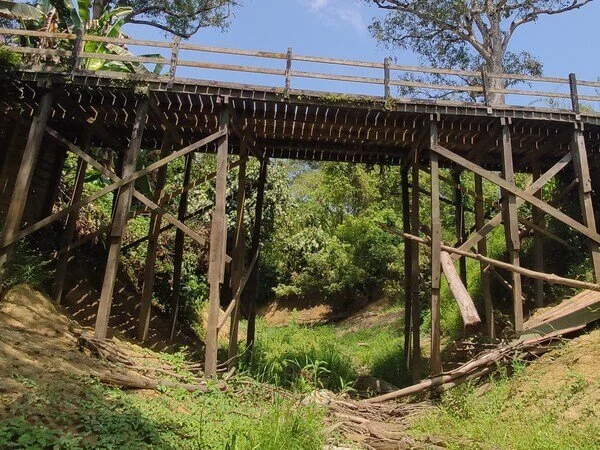
This isn’t just marketing durability. It’s centuries of structural proof.
When international markets talk about “Indonesian ironwood,” this is usually what they mean.
And this is the material we work with at Kaltimber.
But we don’t just source Ulin — we recover it.
Our Ulin is 100% reclaimed from structures genuinely slated for demolition in Kalimantan. These beams and decking boards have already proven themselves for decades before reaching us. We do not harvest. We give existing material a second life.
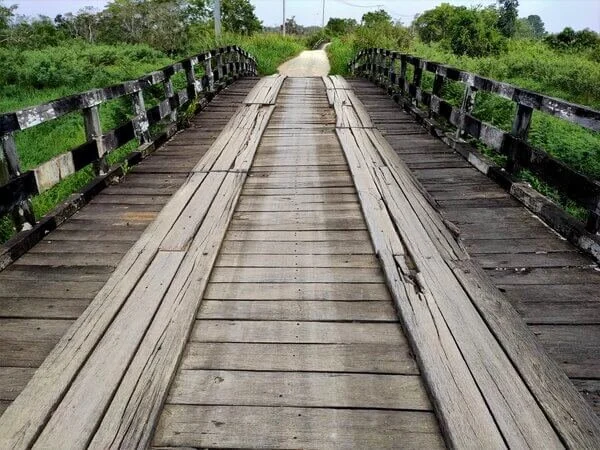
That history matters.
So What About Sulawesi Ironwood?
Yes — in Sulawesi you’ll absolutely hear the term kayu besi.
But most of the time, it is not Ulin (Eusideroxylon zwageri).
Instead, the name may refer to different dense local hardwoods. Strong? Often yes. Heavy? Usually. Botanically the same as Ulin? No.
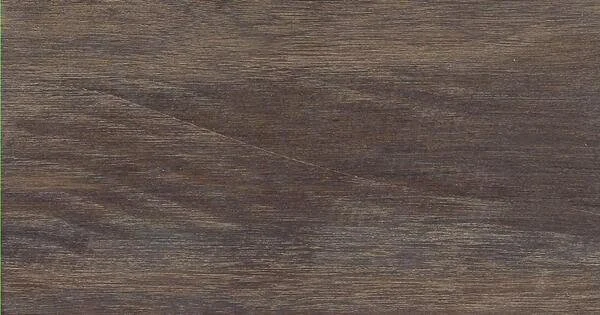
There isn’t one single official “Sulawesi ironwood species.” It’s more of a regional naming habit based on hardness.
And that’s where confusion starts.
Other Woods That Get Called “Ironwood”
Across Indonesia, several hardwoods sometimes carry the ironwood label:
Merbau (Intsia spp.)
Found in Papua, Maluku, and eastern Indonesia.
Dense, durable, widely used for decking and flooring.
Sometimes marketed internationally as ironwood because of its hardness.
Bangkirai (Shorea laevis)
Strong and widely used outdoors.
Occasionally referred to as ironwood in trade contexts — but technically a completely different family.
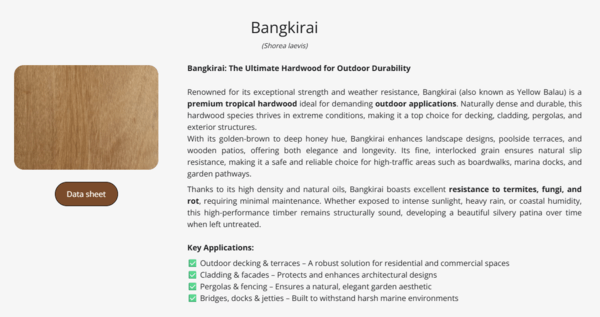
Available at our partner company: Kitaru Lumberyard
Papua “Kayu Besi”
Certain extremely dense species in Papua are locally called ironwood as well. Different forests. Different species. Same nickname.
Why This Happens
Indonesia is one of the most biodiverse countries on earth.
Wood naming here often works on three levels:
Scientific name (botanical classification)
Trade name (what suppliers sell it as)
Local name (what communities have always called it)
“Ironwood” often lives in the second and third categories.
If it’s heavy enough to strain your back…
If it dulls your tools…
If termites struggle with it…
Someone will call it kayu besi.
But density alone does not define long-term structural performance.
Why Species Clarity Matters
Two woods can feel equally heavy but behave very differently in:
Dimensional stability
Cracking patterns
Movement over time
Weather exposure
Structural longevity
Ulin earned its reputation through real-world use over generations.
That track record is part of what makes it different.
And this is exactly why at Kaltimber, we are precise about species. We don’t generalize. We don’t blur names. We don’t substitute one dense hardwood for another and label it ironwood.
Because transparency builds trust.
When we say reclaimed Ulin, we mean Eusideroxylon zwageri, recovered responsibly from existing structures in Kalimantan — not newly harvested, not mixed species, not renamed for marketing convenience.
The Bottom Line
Indonesia does not have many ironwood species.
It has:
Several dense hardwoods across Sulawesi, Papua, Maluku, and Kalimantan
Multiple regional woods that get called “kayu besi” because they are hard and heavy
Same nickname.
Very different trees.
And once you understand that difference, you start asking better questions.